
- Air Operations for GA
- Approval of Flight Conditions
- Balloons
- Classification of Avionics Changes
- Classification of changes (non-avionics)
- CS AWO
- CS-STAN
- EASA types and Annex II types
- Execution of ground tests for compliance showing in a Minor Change Application
- Extended model list
- Fuel
- Grandfathered approvals
- Light Sport Aircraft
- Maintenance
- NOISE – Combination of supplemental type certificates (STCs)
- Orphan aircraft
- Permits to Fly
- Russian aircraft
- Specific Airworthiness Specifications
- STCs
- Validation of FAA STCs classified as Basic and limited to one serial number
Air Operations for GA
May a European NCC or NCO opertator use third-country registered aircraft?
Yes this is permitted
Why are non-commercial operations treated in two parts, i.e. Part NCC (Non-commercial with complex) motor-powered aircraft and Part NCO (Non-commercial with other-than-complex) motor-powered aircraft?
The rules concerning non-commercial operations are developed separately for complex motor-powered aircraft (MPA) and other-than-complex MPA because it does not make sense to have the same requirements apply to operations with an Airbus 320 for example and a Cessna 172. This way, the principle of proportionality of rules is preserved.
What does Part-NCO mean for GA pilots? Can I share flying costs between my friends, are there restrictions covering carrying dangerous goods in GA flights, when do I need to use supplemental oxygen and can I perform special operations (e.g. aerial advertisement).
Approval of Flight Conditions
What should the Applicant do?
In the first instance the Operator should establish whether the defective condition is covered by any of the existing approved data, eg. MMEL, CDL etc..
If none of these options are applicable the next step is to contact their Competent Authority to start the process for the issue of a Permit to Fly. At this stage the operator needs to agree with his Competent Authority whether the Flight Conditions are related to safety of the design. If they are not, then the complete process can be dealt with by the CA.
If the CA determines that safety of the design is affected, then the flight Conditions will need to be approved either by EASA, or by a suitably approved DOA. In many cases the TC holder will have privileges to do this, based on previously approved Flight Conditions agreed with EASA.
If the Flight Conditions cannot be approved either by the CA or by a DOA, then an application to EASA using Form 37 will be necessary. EASA will require technical data to support the application which identifies the defective condition (eg pictures of any visible damage), actions taken to minimise the effects (eg statement from the manufacturer supporting the flight), and proposals for the Flight Conditions (using Form 18b) that further mitigate the situation in order that it can be clearly determined that a safe flight can be performed.
Where it is known that Flight Conditions will need to be approved by EASA, application for these could be made in parallel with the application to the CA for a Permit to Fly.
Why do I need Flight Conditions Approval?
Because the Permit to Fly will be issued on the basis of the approved flight conditions, and these will identify the limitations applicable.
Who can Approve Flight Conditions?
In accordance with Part 21A.710 EASA is normally responsible for the approval of Flight Conditions where they relate to safety of the design. However, certain DOA holders may have the privileges to approve flight conditions related to safety of the design. Where the Flight Conditions are not related to safety of the design, they may be approved by the competent authority.
What is the EASA responsible for?
As described above, EASA is normally responsible for the approval of the flight conditions on the basis of which a permit to fly can be issued by the Competent Authority.
The Agency approves the Flight Conditions in cases related to the safety of the design, defined as follows:
- the aircraft does not conform to an approved design; or
- an Airworthiness Limitation, a Certification Maintenance Requirement or an Airworthiness Directive has not been complied with; or
- the intended flight(s) are outside the approved envelope.
How can I submit an application?
Applications for the approval of flight conditions can be sent at any time by e-mail or regular mail to:
European Aviation Safety Agency
Applications and Procurement Services Department
Manager of the Product Applications Management Section
Postfach 10 12 53, D-50452 Köln, Germany
E-Mail: flightconditions [at] easa.europa.eu (flightconditions[at]easa[dot]europa[dot]eu)
The process for applying for the PtF from your Competent Authority is detailed on their website or in their publications.
In the event of an emergency situation occurring outside office-hours, during week-ends or public holidays, your Competent Authority can contact EASA directly.
Balloons
What approval is required for navigation, radio and transponder equipment for balloon operations?
EASA published the ‘Balloon Rule Book - Easy Access Rules’, which is a ‘one stop shop’ book gathering texts relevant to balloons. You will find there the requirements BOP.BAS.355 for radio-communication equipment and BOP.BAS.360 for Transponders. They both fall under the umbrella of BOP.BAS.300, that states that ‘(a) Instruments and equipment required by this Section shall be approved in accordance with Annex I to Regulation (EU) No 748/2012 if one of the following conditions is fulfilled: (1) they are used to comply with points BOP.BAS.355 and BOP.BAS.360; (…)’.
Radio-communication and transponders therefore need to be approved, and this is a hook to 21.A.305. This latter requirement states that ‘In all cases where the approval of a part or appliance is explicitly required by Union law or Agency measures [that is the case here because of BOP.BAS.300], the part or appliance shall comply with the applicable ETSO or with the specifications recognised as equivalent by the Agency in the particular case.’ In the absence of an equivalent specification, the transponder or radio-equipment should comply with the corresponding ETSO standard. This can be easily demonstrated by holding an ETSOA or an equivalent foreign TSOA that is automatically accepted by EASA (e.g. FAA TSOA or TCCA CAN-TSOA).
Further BOP.BAS.300, that states that (b) By way of derogation from point (a), all of the following instruments or equipment, when required by this Section, shall not need an approval: (1) instruments or equipment used by the flight crew to determine the flight path;
Further EASA considers balloon equipment as portable equipment, if it is fixed by velcro, carabiners or put in pouches, meaning no tooling is required to install the equipment in the balloon. Portable equipment does not require an installation approval.
Classification of Avionics Changes
How does EASA classify antenna installations?
This question is answered by reference to the table FAQ table of design change classification.
How does EASA classify single and dual GNS4xx/5xx installations?
This question is answered by reference to the table FAQ table of design change classification.
How does EASA classify Transponder Mode S Diversity and dual Transponder installations?
This question is answered by reference to the table FAQ table of design change classification.
How do I know whether my proposed change is Minor or STC?
This question is answered by reference to the table FAQ table of design change classification.
Classification of changes (non-avionics)
What might lead to an "acoustical change"?
A light propeller driven aircraft's certificated noise level is dependant on two factors, the aircraft's noise at source and the aircraft's take-off performance as defined the AFM. An adverse change to either could lead to a finding of an "acoustical change".
Factors that might adversely affect an aircraft's noise at source
The two principle sources of noise are the propeller and the engine.
Propeller noise is highly dependent on the propeller helical tip Mach number. Other factors that influence propeller noise include the number of blades, blade tip shape, blade thickness and the inflow angle of air flowing into the propeller. Any change that could affect any of these factors is potentially an acoustical change.
Such changes would include:
- An increase in take-off rpm ("red line"), or highest rpm in the normal operating range ("top of green arc");
- A change leading to an increase in the best rate of climb speed (Vy);
- An increase in propeller diameter;
- A change to the propeller tip shape;
- An increase in the propeller blade thickness;
- A change in the number of propeller blades;
- The installation of a variable pitch propeller in place of a fixed pitch propeller;
- Any change in the propeller inflow angle.
Engine noise is directly related to engine power. Many engines are fitted with noise suppression devices. Any change that increases engine power or modifies in any way the engine exhaust or the performance of the mufflers, if fitted, is potentially an acoustical change and should be referred to C.1.6.
Factors that might adversely affect an aircraft's take-off performance
The noise certification reference take-off procedures are defined in terms of the approved take-off distance (D15), rate of climb (ROC) and best rate of climb speed (Vy). Any change that causes an increase in D15, a decrease in ROC or a change in Vy will potentially mean the aircraft is lower when it overflies the microphone and therefore noisier.
Such changes would include:
- An increase in take-off weight;
- A decrease in engine power;
- In the case of an aircraft where take-off power/rpm is time limited a change in the period over which take-off power/rpm may be applied;
- A change that increases the aircraft's drag (e.g. the installation of external cargo pods, external fuel tanks, larger tyres to a fixed undercarriage, floats etc.).
Other factors to be taken into account
Aerodynamic noise, although potentially a significant source of noise for large aircraft, is not generally a significant source for light propeller driven aircraft. Modifications such as the fitting of vortex generators, drooped leading edges or gloves, and extensions or re-profiling of the wing tips would not themselves be considered to be acoustical changes.
However such modifications are often associated with an increase in take-off weight and may therefore be considered as "acoustical changes". A modification to an aircraft that involves the removal of such devices might also be considered to be an "acoustical change" since their removal may lead to a deterioration in the aircraft's performance.
In addition such changes may affect the aircraft incidence during climb-out and potentially change the propeller inflow angle which might itself constitute an "acoustical change".
How does EASA treat my uncertificated ultralight/microlight aircraft?
If the aircraft comes within the definition of Annex II to the Basic Regulation, it is not an EASA type and is handled under national rules. If it does not fit into this definition it is an EASA type and is covered under the procedures below.
When do the noise aspects of a propeller and/or engine lead to a classification as major or STC?
Any change that has an "appreciable effect" on the noise characteristics of an aircraft is referred to as an "acoustical change", and by definition is considered to be a major change. An "acoustical change" is defined as a change that increases the noise certification level by more than 0.1 dBA.
CS AWO
What is meant with “automatic landing system” in CSAWO.A.ALS.101(a)? Does Subpart A apply to general aviation aircraft (eg certified according to CS 23) approved for IFR and with autopilot installed?
As explained in AMC AWO.A.ALS.lOl(a) the term 'automatic landing system' (ALS) refers to the airborne equipment which provides automatic control of the aeroplane during the approach and landing. “Automatic landing” should be understood in this respect as “use of autopilot until touchdown”. This capability is typically referred to as “autoland”.
IFR General aviation a/c with autopilot, do not have such capability (until touchdown), so subpart A does not apply.
It is highlighted though that for IFR general aviation aircraft with autopilot and performing category 1 operations, section 1 of subpart B of CS AWO issue 2 applies which clarifies that the relevant specifications of CS 23 shall be met.
CS-STAN
Does CS-STAN allow the installation of Garmin GNS devices?
The main functionality of these devices is COM/NAV/GPS. CS-SC052b (GNSS equipment) allows the combination with CS-SC001 (COM) and CS-SC056 (NAV). Thus its installation can be considered eligible for CS-STAN. However, the limitations of CS-SC52b have to be respected. In particular, any connection with an autopilot is not permitted, since such use would go beyond the limitation to situational awareness only.
Does CS-STAN allow the installation of Garmin GTN devices?
The functionality of the Garmin GTN series exceeds the one covered by CS-SC052b and thus its installation is not eligible for CS-STAN.
Garmin is holding an STC with a comprehensive AML for the installation of the GTN series. In cases where a European type is not listed on that AML, due to the absence of a FAA TC, the process of a minor modification or Form 134 could be used to extend the applicability of the STC, if agreed by EASA.
Does CS-STAN allow the installation of digital multifunction engine monitoring devices (e.g. EDM 900)?
CS-SC201a explicitly excludes the installation of digital multifunction devices.
Is there any AMC/GM related to CS-STAN?
AMC to M.A.801: Easy Access Rules for Continuing Airworthiness
AMC to 145.A.50 referring to M.A.801
GM to 21.A.90B and 431B referring to M.A.801
Clarifications on installation of an ADS-OUT system combined with a transponder system (CS-SC005a) – Configuration 3
This SC is for the installation of an ADS-B OUT system that is combined with a transponder in a single unit. The Configuration 3 describes the particular case of installation of a transponder that contains an ADS-B OUT system and a GNSS position source that is not approved.
Therefore, the conditions for configuration 3 shall read as:
- The ADS-B transmit unit forms part of the Mode S transponder equipment. The transponder equipment and its installation are compliant with CS-SC002c or later amendments, or are otherwise approved.
- The GNSS receiver is not approved or its installation is not certified. However, the compatibility of the combination of the transponder and the GNSS receiver is explicitly stated by the manufacturer of the transponder.
- The quality indicators are configured according to the manufacturer instructions to report the lowest quality (e.g. SIL = 0 and SDA = 0, NACp = 0). — The installation instructions from the equipment manufacturer have to be followed.
EASA will implement this correction in a revision of CS-STAN issue 3 in the upcoming months, together with other corrections as necessary.
Clarifications on installation of an ADS-OUT system combined with a transponder system (CS-SC005a) – Portable units
The use of ADS-B portable units is not covered by CS-STAN.
Additionally, the usage of ADS-B portable units must be authorised by the National Aviation Authorities and by the Air Navigation Service Providers. Simultaneous ADS-B OUT transmissions from the same aircraft (e.g. installed + portable ADS-B OUT) has a negative impact on Air Traffic Services because it creates interference. Pilots and aircraft owners should make sure that an installed Mode S transponder does not broadcast ADS-B OUT parameters simultaneously with an allowed portable ADS-B OUT unit (e.g. as part of ADS-B trials organised by Air Navigation Service Providers). However, there is no restriction on the usage of an ADS-B IN only portable unit (reception of ADS-B transmissions).
EASA types and Annex II types
How do I know whether my aircraft is an EASA type?
The EASA aircraft lists can be found in the Product Certification page and there are separate links for EU and non-EU products. Annex II types are, by definition, not EASA aircraft and are therefore handled under national rules.
Execution of ground tests for compliance showing in a Minor Change Application
How can I perform a ground test for showing of compliance (using “not yet approved” design data) in a Minor Change Application?
Preliminary remark: This FAQ is aimed to provide guidance on how to perform a ground test for a minor change application (Example: a minor change for the installation of a radio or transponder), and how the actions between the MC applicant and the installer shall be shared.
IMPORTANT: the following is valid only in cases where the ground test is needed to prove that the design change complies with the certification requirements. In many cases the ground tests are “post-installation tests” to check functionality and conformity for the release of the installation. In such cases the instructions below are not needed since the test would be done based on already approved data.
The following definitions and abbreviations will be used (limited to the scope of this FAQ):
- MC: minor change;
- MC Applicant: the Applicant (organisation or person) to EASA for the minor change approval and the owner of the design data that will be approved with the minor change;
- Installer: The organisation/person that will perform the modification of the aeroplane according to the MC design data and will release to service the aeroplane (note: According to part M.A.801 of EU regulation 1321/2014, this can be in some cases a person: certifying staff or the pilot owner). It is acknowledged that in most of the cases the MC applicant and the Installer are the same entity;
- Certified aircraft: the aircraft that is used for the ground test. Typically this is an aeroplane with its own CofA (Certificate of Airworthiness) that will be modified with the MC design data.
In cases, a certified aircraft is modified and used for the ground test to show compliance to the airworthiness requirements, the following shall be considered:
- Test plan: The MC applicant shall issue a test plan;
- Design data: the certified aircraft shall be modified using design data (drawing, specifications, procedures) provided by the MC applicant clearly identifiable as “not approved data”. IMPORTANT: Any instruction shall contain a statement like: “The approval status of the technical content of this document is limited to demonstration of compliance purposes only. Final approval is pending the approval of EASA minor change Project Nr. XXX. The aircraft shall not be released to flight before evidence of final approval is provided”;
- Aircraft modification: the installer modifies the aircraft using the design data provided by the MC applicant. The installer shall report all discrepancies (if any) to the MC applicant;
- Tests Configuration: The installer prepares the aircraft and the test equipment for test configuration. The conformity to the configuration required for tests should be checked together with the MC applicant;
- Test execution: The installer (or the MC applicant) performs the test and provides the test results. Tests can be also performed by a third party. Ultimately, it is the responsibility of the MC applicant to check the correctness of the test execution;
- Approval of modification: after test results have been received and accepted, and the rest of the compliance documents are also accepted, the approval is issued by EASA. Following issue of the approval, the MC applicant provides the installer with the final set of design data (in most cases they will be the same as the ones provided for test execution, but it could happen that the final set of design data provided for modification needs to be changed, in which case the installer shall be informed accordingly) and remove/replace the initial statement with the following statement: “the technical content of this document is approved with EASA approval XXXX).
- Flight tests for development / compliance demonstration: the above bullets can be considered in principle also for flight tests, with the difference that in this case, a Permit to Fly will be needed and corresponding rules of Part-21 Subpart P shall be followed.
A similar topic is treated in EASA document “GOOD PRACTICES ‐ First Installation of a Change to a Product” for DOA installing STC.
Extended model list
Use of extended model list in case of minor changes for common replacements (box out - box in) of basic avionics equipment (e.g. transponder)
The replacement of avionics is a change to the type design that has to be approved in accordance with Part-21, and, for that, it has to be classified as major or minor, depending on the effect that the change has on the airworthiness of the A/C. The rules for the classification are identified in paragraph 21.A.91 and the guidance in the GM 21.A.91. Additional guidance can be found in the FAA AC 23.1309-1E and the “FAQ table of design change classification”.
Regarding the applicability of the change, each application need to include a reference to the TC and the eligible A/C type/model to be changed. As indicated on EASA website at the FAQ for Fees and Charges, one application for TC, RTC, STC, Major and Minor Change can cover several models but not more than one type per certificate.
There are, however, some exceptions where a list of models, applicable to aircraft covered by different TC’s, has been accepted. In such case, it has to be shown that the design change and the demonstration of compliance is valid, without relevant differences, on all the TC’s/models listed in the paragraph on the applicability of the modification.
Modifications consisting of a replacement (“box out – box in”) of basic avionics (e.g. transponder) represent one of such exceptions. In order for a design change to fall in this category, where an extended model list of A/C from different types can be accepted, the following criteria should be met:
- The design change is classified as minor according to Part 21.A.91;
- A proper and detailed model list is provided;
- A common certification basis in the Area of the change can be applied;
- Commuter category is excluded;
- The design change must be a pure replacement (“box out – box in”);
- For equipment located on the flight deck, it must be replaced by equipment which utilises the same location as the equipment which was removed;
- The validity of the modification design has been checked and justified in writing for all the models in the list;
- The minor classification is valid for all the models on the list. This means that the conditions that make the classification minor are valid for all the models (and categories) and no limitation is invalidated (example: installation of transponder on A/C with cruise TAS greater than 250 kts, is major);
The following conditions also apply:
- The mass of the new equipment is not significantly higher;
- Cables and Antennas have not changed (change of the mating electrical connector on the aircraft is accepted);
- The equipment does not add any new functionality.
Meeting all the above conditions typically allows acceptance of applications with extended model list. When one or more of the above conditions are not met, a case by case evaluation is possible. In both cases, acceptance will not constitute a precedent for any future change.
Fuel
May I use Unleaded Aviation Gasoline (Avgas) UL 91 even if the airframe TCDS states that the minimum fuel octane is 100?
The use of Avgas UL 91, when this fuel grade has been approved for the particular engine types, is possible even if the airframe TCDS specifies a higher minimum number of octane (e.g. Avgas 100LL). In this case, the Avgas UL 91 can be used after implementation of the related Standard Change CS-SC202b, see page 48/49 of CS/STAN
This Standard Change is suitable for aeroplanes that are approved for operation
with Avgas or Mogas in case the installed engine is already approved to use unleaded Avgas UL 91, leaded Avgas 80/87, or Mogas RON 95 (MON 85) in accordance with Standard EN228.
The previously published EASA SIB 2011-01 has been withdrawn after publication of CS-STAN “Standard Changes and Standard Repairs”.
IMPORTANT: Use of unleaded Avgas UL 91 in engines that have not been approved for the use of these fuels may cause extensive damage or lead to in flight failure, due to the lower Motor Octane Number (MON) of the fuel, compared to Avgas 100LL.
Grandfathered approvals
What are grandfathered approvals?
Any STC approved or validated by any member state before the establishment of EASA is deemed to be approved under Regulation (EC) No 1702/2003 Article 2a. This covers all previous approvals from minor changes to major changes, STCs and complete aircraft, both certifications and validations with the exception of products of the former Soviet Union. It also covers the flight conditions approved for aircraft operating under national Permits to Fly issued before 28 March 2007.
Light Sport Aircraft
How does EASA deal with Light Sport Airplanes?
A Light Sport Airplane (LSA) is a simple two-seater with a maximum take-off weight of 600kg. Commission Regulation (EC) No 748/2012 (Part 21) issued on August 2012, introduced a new process for the European Light Aircraft (ELA) that, together with the certification specifications CS-LSA published in 2011, create a lighter regulatory regime for the EASA certification of LSA aircraft.
Before the ELA process was in place an EASA Permit to Fly (PtF) according to Regulation (EC) No 1702/2003 (as amended by Regulation 375/2007) Part 21A.701 (15) was an option. The principles for the issuance were based on the rulemaking task MDM.032. With the new ELA process a PtF according to 21A.701(15) is no longer appropriate and the approval of flight conditions will be gradually stopped during the next 2 years and 6 month period. During this transition period all the LSA aircraft flying under PtF will need to obtain a normal or restricted Certificate of Airworthiness, after inspection and, if necessary, modification. The conditions and time schedule for the transition period are explained in the following document:
Permit to Fly principles:
- The ASTM Standard for light sport aircraft is accepted as a "certification" basis for issuing a permit to fly following Part21A.701 (15) until such regulations are in place in Europe.
- The permit to fly will have a limited validity (2 years) and will not be extended when ELA-rules are in place in Europe.
- A permit to fly based on Part 21A.701 (15) is only valid for non commercial activities according to the Basic Regulation .
- There is no automatic transfer of these PtF into another kind of EASA approval. As an EASA certification following ELA processes will be appropriate in future the PtF has to be replaced.
- Showing of compliance (load analysis, static test, flight test etc.) has to be done and the EASA needs to be satisfied that the aircraft is able to perform safe flights when operated according to the approved flight conditions. The approval can only be granted for the MTOM for that the showing of compliance with the requirements is valid.
- The involvement of the "holder of the type design" is required for establishing the flight conditions as the future regulation will define some kind of TC and TC-Holder obligations according to Part 21 and the showing of compliance with ASTM Standard requires detailed knowledge of the design. In absence of a TC-Holder private owners need to organize themselves and find an acceptable organisation performing the required "certification" activities.
- For the first application a more detailed review of the documentation for ASTM "Certification" will be done and flight conditions will be developed. For the following applications the process can be simplified and the agreed flight conditions can be approved when manufacturing documentation and inspection reports are submitted.
- With approved flight conditions registration of the aircraft is possible in all EU member states.
- Pilot licence needed is at least the national licence for an aeroplane in that weight category.
- A maintenance regime has to be defined following basic principles of "new" Part-M.
- Limitations will prohibit at least IFR, Night VFR, Aerobatics, Solo-Training.
- Modifications of the aircraft require a new approval of flight conditions.
Alternative (Restricted) Type Certification
As there are still some open issues left e.g. for issue of CofA for such PtF aircraft an alternative way should be mentioned. Without ELA processes there is already the possibility to get a certification for products not fully conforming to CS-VLA and Part 21.
- As the ASTM Standard needs to fulfil the essential airworthiness requirements of Basic Regulation it can be applied using a special condition with public consultation.
- When engine and propeller have no type certification EASA has already the option to accept a restricted type certification for such an aircraft.
- Holder of such an (restricted) TC needs to demonstrate their capability through design organisation approval (DOA) or alternative procedures to DOA.
- Manufacturing requires production organisation approval
- Maintenance needs to be done according to Part-M.
EASA Definition Light Sport Aeroplane
Light Sport Aeroplane complies with the following criteria:
- A Maximum Take-Off Mass of not more than 600 kg
- A maximum stalling speed in the landing configuration (VS0) of not more than 45 knots CAS at the aircraft's maximum certificated Take-Off Mass and most critical centre of gravity.
- A maximum seating capacity of no more than two persons, including the pilot.
- A single, non-turbine engine fitted with a propeller.
- A non-pressurised cabin
These specifications apply to aeroplanes intended for "non-aerobatic" and for "VFR day" operation only.
The airworthiness code is ASTM International standard F2245.
The Multi-Disciplinary Measure (MDM) group MDM.032 is working on proposals to reduce the regulatory burden on these recreational aircraft. These changes to the regulations, when in place, will replace the interim measures set out above.
Maintenance
Maintenance for each type of aircraft/operation
Maintenance for each type of aircraft/operation
|
|
MAINTENANCE |
||
|
Commercial operations |
Licenced air carriers [1] |
Maintenance to be performed by Part-145 organisations |
|
|
Commercial specialised operations or CAT other than licenced air carriers or commercial ATOs |
Complex motor-powered aircraft [2] |
Maintenance to be performed by Part-145 organisations |
|
|
Other than complex motor-powered aircraft (CMPA) |
Maintenance to be performed by: Part-M Subpart-F organisations; or, Part-145 organisations. |
||
|
Other than commercial operations |
CMPA |
Maintenance to be performed by part-145 organisations |
|
|
Other than CMPA and limited operations [3] |
Maintenance may be performed by: Part-145 organisations, Part-M Subpart-F organisations, Independent certifying staff, or, Pilot-owner maintenance [4] |
||
[1] Licensed air carriers are EU air carriers holding an operating licence in accordance with Regulation (EC) 1008/2008
[2] Twin turboprop aeroplanes of 5 700 kg MTOM and below can be exempted by the Member State from complying with any requirements applicable to CMPA and shall instead comply with the requirements applicable to other than CMPA.
[3] Limited operations are defined in Regulation (EU) 1312/2014 Article 2(p)
[4] Only limited to non-CMPA of 2730 kg MTOM and below
What are the alleviations introduced by M.A.302(h) on the maintenance programme for General Aviation?
In accordance with M.A.302(h), for ELA1 aircraft not involved in commercial operation, the owner, whether he has contracted a CAMO or not [see M.A.201(i)], has the option not to submit the Aircraft Maintenance Programme (AMP) to the competent authority for approval, but instead ‘declare’ an AMP, subject to compliance with the conditions described therein. In this respect, the owner may decide to deviate from the applicable scheduled maintenance recommendations (see also remark below) without the need to justify such deviation(s), but under his/her full responsibility. Such declared AMP does not need to be sent to the competent authority.
In this scenario though, the declared AMP shall not be less restrictive than the ‘Minimum Inspection Programme’ (MIP) referred to in point M.A.302(i).
In addition, such declared AMP shall be reviewed annually and this review can be done either by the person who performs the airworthiness review, during the accomplishment of the airworthiness review, or by a CAMO if contracted to manage the continuing airworthiness of the aircraft [see M.A.302(h)5].
Besides, if during the airworthiness review it is observed that there are discrepancies on the aircraft linked to deficiencies in the content of the maintenance programme, the competent authority shall be informed and the AMP amended.
Remarks:
- In accordance with M.A.302 and in particular M.A.302(h)(3), the AMP, declared or approved, shall in all cases include all the mandatory maintenance/continuing airworthiness requirements, such as repetitive Airworthiness Directives or the Airworthiness Limitation Section (ALS).
- In accordance with Part-M Appendix VIII point (b)(9), the tasks that are part of the annual or 100h check contained in the ‘Minimum Inspection Programme’ do not qualify for pilot-owner maintenance referred to in M.A.803.
References:
Please refer also to AMC M.A.302(e) (maintenance programme template), AMC M.A.302(h), GM M.A.302(h) and AMC M.A.302(i) (content of MIP).
Please refer to Article 2 (point k) of Regulation (EU) 1321/2014 for the definition of ELA1.
Please refer to Article 3 (point i) of Regulation (EU) 216/2008 (Basic Regulation) for the definition of commercial operation.
NOISE – Combination of supplemental type certificates (STCs)
How does EASA deal with Noise – Combination of supplemental type certificates (STCs)?
For the certification/validation of STCs, the STC holder shall demonstrate compliance for the configurations defined in the TCDS plus the change introduced by the STC. Combinations with other STCs may be considered, but this is not common practice.
Aircraft owners planning to install more than one STC should check before embedding them in the EASA Noise database whether a noise record has been established for this configuration.
If the configuration cannot be found, in most cases one of the STC holders must apply at EASA to establish a noise level. This is a prerequisite to register the S/N in Europe.
For any further question, please contact noise [at] easa.europa.eu.
Orphan aircraft
How does EASA deal with aircraft without a Type Certificate holder?
An aircraft becomes orphan when:
- the legal person holding the Type Certificate (TC) has ceased to exist. The TC automatically becomes invalid by law because there is no one to be in compliance with the TC holder’s responsibilities (21A.51 (a) 1 and 21A.44); or
- the TC holder no longer complies with his regulatory obligations. A typical case is when the TC holder ceased to exist, or fails to comply with 21.A.14. This makes the TC invalid (21A.51 (a) 1); or
- the TC holder has surrendered the TC. This also makes the TC invalid (21A.51(a)2).
Under Part 21, orphan aircraft cannot be issued a Certificate of Airworthiness, which requires that a TC holder takes responsibility for the continued oversight of the design.
Aircraft that became orphan before 24 July 2018 and for which EASA issued an SAS for their type design may continue to be operated if they hold a restricted certificate of airworthiness.
Aircraft that become orphan in the future will no longer be allowed to be operated.
Permits to Fly
Who can issue a Permit to Fly?
In accordance with Part21A.711, the competent authority of the member state of registry is normally responsible for the issue of a Permit to Fly. Appropriately approved design or production or continuing airworthiness management organisations may also issue a Permit to Fly within limitations specified in Part 21.
When do I need a Permit to Fly?
When my aircraft does not meet, or has shown not to have met, applicable airworthiness requirements and as a result does not hold a valid Certificate of Airworthiness or Restricted Certificate of Airworthiness, but is capable of a safe flight under defined conditions and for the purposes listed on point 4.2 of Form 37 (Application for Approval of Flight Conditions for a Permit to Fly).
Note that the Member State of Registry can also grant an exemption to allow an aircraft to fly without a valid Certificate of Airworthiness or Restricted Certificate of Airworthiness under the provisions of Article 71 of the Basic Regulation (Regulation (EU) 2018/1139), if it finds that the conditions of this article are met.
Russian aircraft
How does EASA deal with Russian general aviation (GA) aircraft types Su-26, Yak-54, Yak-55, Su-29, Su-31, and Yak-18T?
When it comes to the above mentioned Russian GA aircraft types, the situation can be described as follows:
1) Aircraft covered by transitional arrangements:
A limited number of the above mentioned Russian GA aircraft types have been covered by transitional arrangements (identified by serial number) .
According to article 5 of Regulation 748/2012, for a certain number of Russian GA aircraft that were on a Member State´s register before the applicability of the Basic Regulation, the Agency has developed Specific Airworthiness Specifications (SAS) on the basis of which the aircraft are eligible for the application for a Restricted Certificate of Airworthiness (RCofA) at the Member State´s NAA in accordance with art. 21.A.173(b). However, this only applies to the aircraft specifically listed (by serial number) in the SAS (SAS.A.093 for Su-29; SAS.A.094 for Su-31 and SAS.A.095 for Yak-18T).
Additionally, for aircraft that, although in the register of one of the Member States at the date of applicability of the Basic Regulation, could not fulfil all the criteria of article 5 for the issue of an SAS, the Agency has issued flight conditions which have allowed these aircraft to continue to fly based on a national Permit to Fly. This was done based on the same grandfathering principles (to cover aircraft already registered in the Member States), based on information received from the Member States of registry, and limited to a restricted number of individual aircraft (identified by serial number).
Only individual aircraft that were registered in one of the Member states before the date of applicability of the Basic regulation to that State were covered by the transitional arrangements described above.
The dates of applicability of the Basic Regulation for the various EASA Member States are:
- 27. September 2003: Austria, Belgium, Denmark, Finland, France, Germany, Greece, Ireland, Italy, Luxemburg, Portugal, Spain, Sweden, The Netherlands, United Kingdom.
- 1. May 2004: Czech Republic, Cyprus, Estonia, Hungary, Latvia, Lithuania, Malta, Poland, Slovak Republic, Slovenia.
- 1. June 2005: Iceland, Norway, Liechtenstein.
- 1. December 2006: Switzerland.
- 1. January 2007: Bulgaria, Romania.
- 1. July 2013: Croatia.
2) Aircraft not covered by transitional arrangements:
For all other Russian GA aircraft of the types listed above, the general procedure according to Part-21 applies. This means that applicants for the approval of flight conditions by the Agency need to demonstrate “that the aircraft is capable of safe flight under the specific conditions and restrictions” (art. 21.A.710c), hence need to provide the Agency with a comprehensive certification plan for each application/aircraft. The certification plan should consider the relevant Certification Specification (CS) for the aircraft (e.g. CS-23) as well as for engine (e.g. CS-E) and propeller (e.g. CS-P). Also, the continued airworthiness of the aircraft needs to be ensured.
Specific Airworthiness Specifications
How to move an orphan aircraft from Restricted Certificate of Airworthiness (RCoA) to an EASA Permit to Fly (PtF)?
For a number of reasons, an aircraft owner may wish to move an orphan aircraft from a Restricted Certificate of Airworthiness (RCoA) which has been issued based on an existing Specific Airworthiness Specification (SAS) to a Permit to Fly (PtF).
Several (at present mostly) French built orphan aircraft types of the same basic Type Design are operated under RCoA (based on SAS) and also under PtF. The service experience, based on occurrence data available at DGAC, suggests that currently a safety risk does not exist when aircraft are moved from an SAS (RCoA) to a PtF. On the basis of this evidence EASA policy is to allow any aircraft with an SAS (RCoA ) to transfer to a PtF if the owner requests.
The transfer process is initiated by sending both EASA Forms 37 to EASA online, together with drafted Flight Conditions (FC). The fees for the approval of the FC are invoiced iaw. actual Commission Regulation on Fees and Charges.
Once the Flight Conditions (FC) have been approved by EASA, an EASA PtF is issued by the Competent Authority of the State of Registry (SoR) based on the approved FC. This involves the applicant making a separate application to the Competent Authority of the SoR.
If the technical aspects of an FC are deemed to be generic for a specific type or model, they will be published together with the appropriate SAS. Where there is a need, Generic Flight Conditions (GFC), if not yet existing, will be developed by EASA in cooperation with the National Aviation Authority (NAA) of the State of Design and added to the SAS.
A Data Sheet (DS) should be understood as an aircraft design definition document and is an essential part of the FC. Such DS will not extend the scope of the SAS (initial TCDS), but specify the design of the particular aircraft at the time of initial PtF issuance. Any later design changes, other than Minor Changes as defined in the FC, have to be approved by EASA by reissuing (approving) of the FC for the affected s/n. Supplemental Type Certificates (STCs) approved/grandfathered before the SAS was issued initially may be used without separate FC approval (this should be clearly indicated in the FC). The same approach is valid for Standard Changes (changes approved per CS-STAN).
In legal terms, Airworthiness Directives (AD’s) do not automatically apply to EASA permitted aircraft. The only way to solve any airworthiness issues is to revoke the EASA approved FC and issue a new FC which specifies the Airworthiness Directive as mandatory. If necessary, the NAAs will be notified by EASA accordingly.
The FC also include a reference to the arrangements for the continued airworthiness regime for the aircraft, which may differ from one SoR to another, depending on local arrangements.
Theoretically, it is possible to move back from a PtF to an SAS (RCoA). During this process the State of Registry should be satisfied that the aircraft in questions meets the SAS type design and has been maintained iaw. Part M in the meantime. However in practice this will be extremely difficult, if not impossible.
How do I find out if my aircraft has an SAS or TC?
The EASA aircraft lists can be found in the Product List page.
These lists specify whether the aircraft has a TC or SAS. This only applies for aircraft (including rotorcraft and lighter-than-air) but not to propulsion. If an engine or propeller becomes an orphan, there is no SAS.
STCs
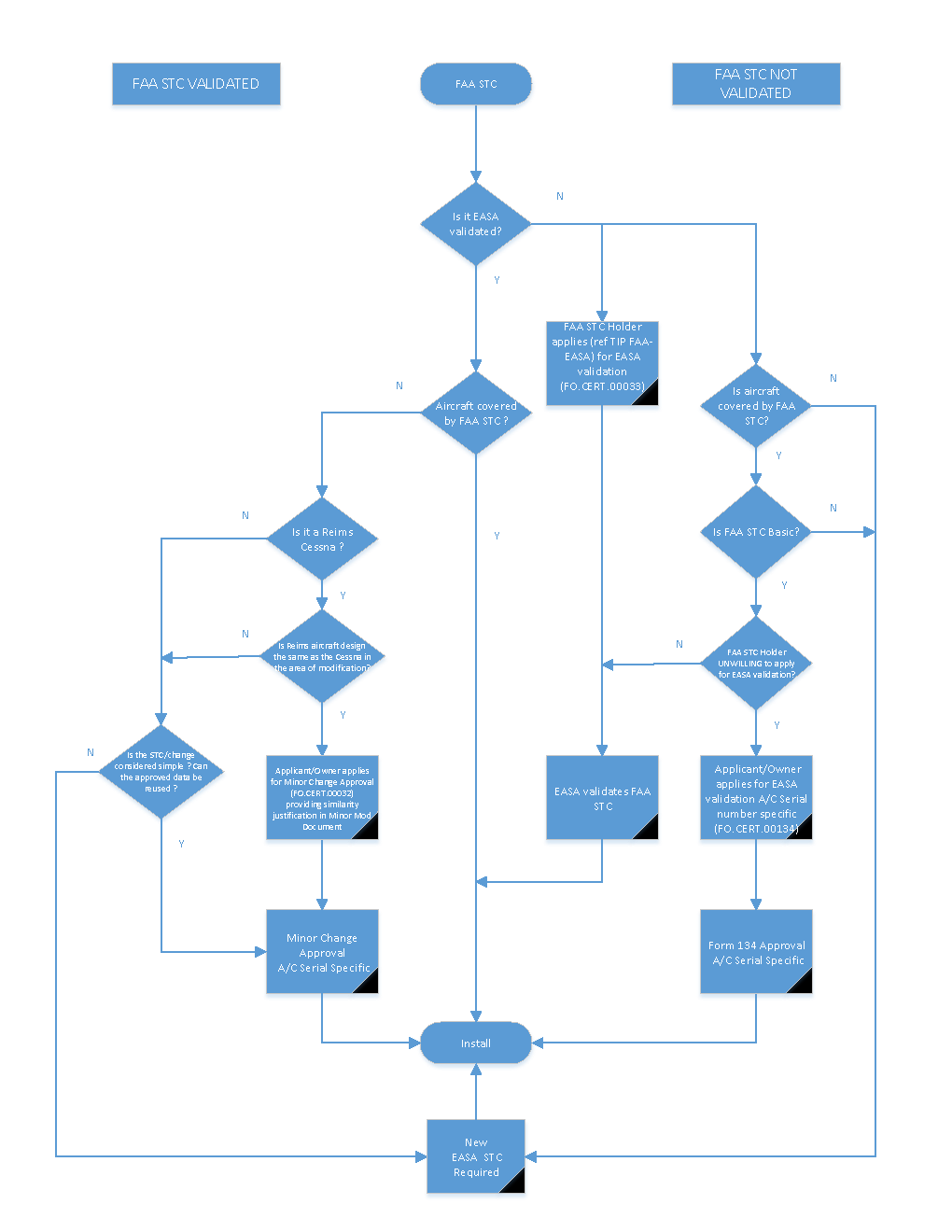
How does EASA deal with STCs on Reims-built Cessna models?
STCs approved on US-built Cessnas and their applicability to Reims-Cessna models.
Reims-Cessna was a French company that manufactured US-designed Cessna aircraft under licence. These included the F150, F152, F172, F177, F182, F337, F406 and their variants. These aircraft were identical to the US-built aircraft but the French aircraft were given DGAC Type Certificates. For this reason, FAA STCs approved for US-built Cessna models do not formally apply to Reims-Cessna models; this also applies to validated STCs. However, because the Reims-Cessna aircraft are identical to the US-built aircraft, and because there is no technical investigation necessary to extend the applicability of STCs to the French-built aircraft, EASA can extend the grandfathered approval to Reims-built aircraft but the approval has to be legally recorded. The mechanism that is used is the minor change, even if the modification would normally be classified as STC (ie, a major change). The applicant should apply on an EASA Form 32 referring to the FAA STC and its EASA grandfathered approval in the application.
Note that all Reims-Cessna models are now covered under FAA Type Certificates, with the exception of the FTB337G and GA which are covered by EASA SAS and the F406, which is still the responsibility of Reims Aviation Industries (RAI).
How does EASA deal with Applicable Model Lists?
In general, an STC can apply to only one Type Certificate. Certain exceptions can be made where the installation of a piece of simple equipment is clearly identical from one aircraft type to another, but EASA procedures state that an STC should apply to one TC only. Each new TC should be the subject of a new application.
This principle also applies to the validation of FAA STCs.
My aircraft has been modified in the USA by Form 337 action. Can EASA accept this?
EASA accepts alterations on non-critical components that are substantiated via Form 337, as detailed in the EASA-FAA Technical Implementation Procedure (TIP) rev 5, paragraph 3.2.8.2 EASA Acceptance of FAA Alteration Data:
“Except for alterations on critical components, FAA-approved or accepted alterations per 14 CFR Part 43 installed on a used aircraft exported from the U.S., regardless of the State of Design of the aircraft, are considered approved by EASA at the time of import to the European Union. EASA shall accept such FAA alteration data when substantiated via an appropriately executed FAA Form 8110-3, FAA Form 8100-9, FAA Form 337 or logbook entry.
Alterations on critical components must be EASA-approved via STC, in accordance with TIP paragraph 2.2 (Design Approval Procedures for Supplemental Type Certificates (STCs)).
An FAA STC whose installation is documented on a Form 337 must be approved by EASA in accordance with TIP paragraph 2.2.”
How do I apply for an STC approval?
Application for STCs are made using the specific form available in the Application forms page.
Applications can be of two types:
- An application from an EU organization for the EASA approval of a new STC.
This requires that the applicant has obtained a Design Organisation Approval (DOA) or Alternative Procedures (AP to DOA). For ELA 1 aircraft or for an engine or propeller installed in ELA1 aircraft an applicant may submit a certification programme for the Agency’s acceptance, in accordance with Regulation (EU) 748/2012 Point 21.A.14(c).
- An application from a non-EU organization for the EASA validation of a non-EU STC.
The application must be made in accordance with a Working Arrangement or Bilateral Agreement.
For example, in the case of STCs issued by the FAA, in accordance with the Technical Implementation Procedure (TIP) between the FAA and EASA, the FAA STC holder must make the application via the FAA Aircraft Certification Office (ACO) that issued the original approval. The ACO must provide a covering letter endorsing and classifying the application (Basic or non-Basic) and forward it to EASA. Applications where EASA agrees with the classification as 'Basic' are normally dealt with quickly.
Validation of FAA STCs classified as Basic and limited to one serial number
What is the EASA administrative validation of the FAA Basic STCs for second hand aircraft, serial number specific?
This is a simplification of the EASA validation process for the cases where the US STC Holder of a FAA STC classified as Basic is unwilling or unable to apply for EASA validation.
The scope is limited to the following product categories and installed engines, if applicable:
- Aeroplanes ≤ 5 700 kg MTOW
- Very Light Aeroplanes
- Light Sport Aeroplanes
- Powered Sailplanes
- Sailplanes
- ELA 1 Balloons or Airships
- ELA 2 Balloons or Airships
- Small Rotorcraft (i.e. Part 27 aircraft with MTOW ≤ 3 175 Kg and limited to 4 seats, including pilot)
- Very Light Rotorcraft
Please note that STCs that involve changes which impact the aircraft’s noise characteristics are excluded from this simplified process.
Please note that High Performance aircraft and commuter are excluded from this simplified process as well as external installations STCs applicable to VLR or Small Rotorcraft.
What does the EU applicant need to do?
The EU applicant needs to:
- check against the latest EASA-FAA Technical Implementation Procedures (TIP) provisions that the FAA STC is Basic, and in this case:
- complete the application form, FO.CERT.00134, “EASA validation of FAA Supplemental Type Certificate classified as Basic and limited to one serial number”,
- acknowledge his/her obligations as Holder of the STC in accordance with Part 21, point 21.A.118A and
- sign the declaration of fulfilling those obligations.
- submit to STC [at] easa.europa.eu:
- the signed application form together with a copy of the FAA STC,
- the applicable documentation available to the applicant (e.g. Master Drawing List, Installation Instructions, Aircraft Flight Manual (AFM), Master Minimum Equipment List (MMEL), Instructions for Continued Airworthiness (ICA) including the published safety documents as Service Bulletins, Safety Information Letters, Airworthiness Directives, etc.),
- if available, the relevant correspondence with the STC Holder (STCH) aimed at demonstrating his unwillingness to follow the normal validation process stipulated in the TIP as well as STCH statement of “no objection to EASA validation”.
What is a FAA Basic STC?
This is a STC meeting the criteria for “Basic” classification stipulated in the current TIP for Airworthiness and Environmental certification between the FAA and EASA at paragraph 3.5.3.1.
What is the classification criteria for Basic STCs?
The classification criteria for Basic STCs are stipulated in the current TIP for Airworthiness and Environmental certification between the FAA and EASA at paragraph 3.5.3.1 and are here listed for your convenience.
Major design changes to a TC, including STCs, are eligible for a basic classification if not impacting any of the following items:
- Any item in the VA Safety Emphasis Item (SEI) list as defined in paragraph 3.5.10.4;
Please consult the EASA lists of SEI for General Aviation and Rotorcraft published at this link.
- The CA or VA certification basis includes or is anticipated to include a new or amended:
(i) FAA exemption or EASA deviation;
(ii) Special condition; or
(iii) Equivalent level of Safety (ELOS/ESF);Please note that this information is typically quoted in the FAA STC.
- A classification of “significant” has been made by the CA in accordance with FAA 14 CFR section 21.101(b) or EASA 21A101(b);
- An AD is affected that was issued unilaterally by the VA; or an AD is affected that was issued by the VA, and where the VA is the Authority for the State of Design for the TC;
- Changes involving the use of a new or different applicable method of compliance from that previously agreed by the CA and the VA;
Note: A method of compliance (MOC) would not be considered “new” or “different” if it had been applied previously in a similar context by both the CA and the VA.
- New technology exists;
Note: New technology is technology that is new to the VA as a whole, not just new to the VA team members. For example, if technology used by the applicant were new to the VA team but not the VA itself, it would not be considered new. It is the VA management’s responsibility to make sure the VA team members are properly informed of the earlier use of the technology, VA standards and MOC.
- Novel applications of existing technology exist;
Note: Novel application of technology is where a particular technology is being used in a manner that causes the precepts of the technology to be questioned. However, it does not mean that existing technology being applied for the first time to a particular product line is automatically novel. Additionally, novel applies to the VA as a whole, not just to a project being assessed by the specific VA team members.
- The applicant has proposed to the CA non-simple substantiations of acoustic or emissions changes, whereas a simple substantiation is when the compliance demonstration with the CA has involved standard means of compliance and procedures which were already regularly agreed by the VA and CA in previous projects of the same applicant (using the same test organization).
- Changes that have an appreciable effect on any one of the Operational Suitability Data (OSD) constituents (refer to EASA Guidance Material GM 21.A.91 to determine an appreciable effect); and
- Any other design change designated as Non-Basic by the CA.
CA stands for Certificating Authority, i.e. the FAA in this case
VA stands for Validating Authority, i.e. EASA in this case
Please note that applicants may not have all the elements and information required for a correct classification. Therefore, the classification proposed by the applicant may be questioned by EASA and eventually not accepted.
Where can I find the application form for this process?
The application form can be found in the document library under applications forms
https://www.easa.europa.eu/document-library/application-forms#certification
https://www.easa.europa.eu/document-library/application-forms/focert00134
Download FO.CERT.00134 - Application for validation of FAA STC classified as Basic and limited to one s/n.
With whom in EASA can I speak about this process?
Please use the mailboxes below, as applicable, for any queries regarding this process.
GADadmin [at] easa.europa.eu
VTOL [at] easa.europa.eu (for VLR and Small Rotorcraft only)
What is the fee charged?
Provided acceptance of the application, applicants will be charged 2 hours at the applicable hourly rate, as per Annex to the Commission Implementing Regulation (EU) (EU) 2019/2153 of 16 December 2019 - on the fees and charges levied by the European Union Aviation Safety Agency- Part II.
What document do I receive?
The application form FO.CERT.00134, “EASA validation of FAA Supplemental Type Certificate classified as Basic and limited to one serial number” contains on page 3 the EASA statement and approval number which will be signed, dated and stamped.
The statement below is proof of EASA validation. Please place this page in the aircraft log.
|
6. EASA Statement - To be filled in only by the European Union Aviation Safety Agency |
||
|
The FAA Supplemental Type Certificate specified in section 3 is classified as Basic and hereby validated for the aircraft identified in section 4. This validation is limited to the serial number under 4.1. |
||
|
EASA Approval Number |
|
|
|
|
|
|
|
Date |
Name |
EASA Signature |